
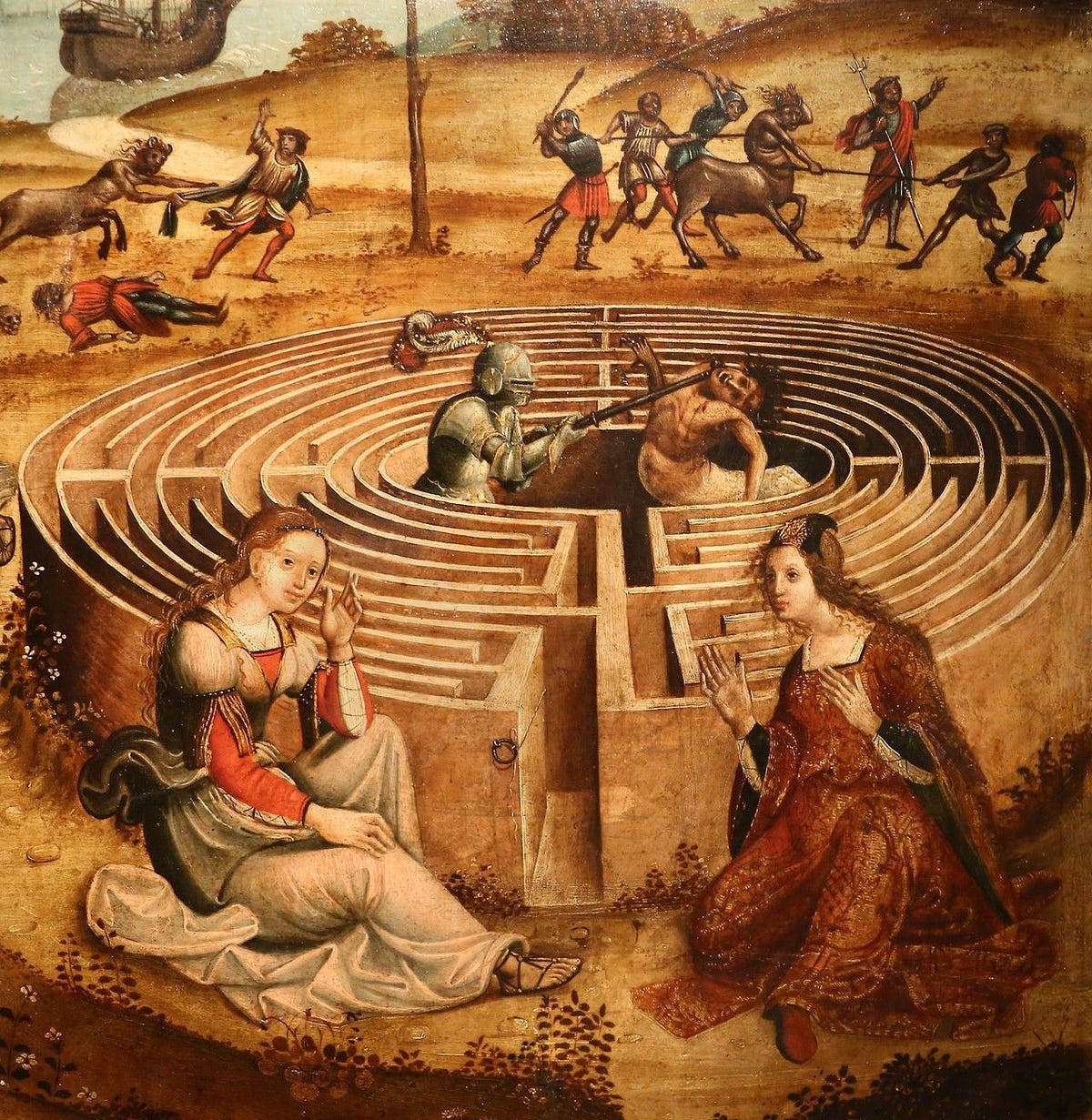
Minotauro é uma criatura da mitologia grega que tem o corpo de ser humano, mas a cabeça e o rabo são de touro. Nasceu fruto da relação de Pasífae, esposa de Minos, o rei de Creta, com um touro dado a Minos por Poseidon. O Minotauro é uma criatura que está presente na mitologia grega aprisionado em um labirinto construído por Ícaro e Dédalo (lembram? Aqueles das asas de cera) a mando do rei de Creta. Minotauro era descrito como um ser monstruoso que devorava pessoas vivas. Quando chegou a Creta, Teseu conheceu Ariadne, filha do rei, e a jovem o presenteou com uma espada e um novelo de linha para derrotar o monstro e conseguir escapar. Teseu matou o Minotauro, fugiu do labirinto e salvou seus companheiros.
O parto humano está preso em um labirinto cuja saída, até então, não conseguimos encontrar. Entramos por um caminho sedutor no início do século passado, com a introdução da tecnologia na atenção ao parto. Parecia que a absoluta artificialização do parto permitiria ultrapassarmos os ancestrais medos que acompanham a sociedade desde épocas primevas. Ao contrário do fato inesperado, a previsão de todos os eventos: ao invés da surpresa, o controle dos tempos. Ao invés das mortes e das dores, a vida resplandecente em cada nascimento. Bastaria para isso a absoluta alienação do processo: o parto passaria das mãos das parteiras às mãos dos cirurgiões; ao invés da do ambiente cálido e acolhedor da casa, o frio asséptico e luminescente das salas cirúrgicas. No lugar dos silêncios, os ruídos metálicos, a conversa dos médicos e o choro das mães. Também trocaríamos as bactérias maternas pelos micro-organismos hospitalares, as antissepsias, as roupas esterilizadas e os necessários antibióticos. Quem ousaria não se contaminar pelo entusiasmo da ciência vencendo a natureza, até então, indomável?
Como toda solução mágica, depois do seu esplendor é possível avaliar suas contradições. A alienação das mulheres cobra hoje um preço muito alto. A troca das especialistas, parteiras altamente capacitadas forjadas nos milênios de vigilância do parto, por cirurgiões, teve como resultado o afastamento da arte ancestral da parteria de sua prática cotidiana. Ao mesmo tempo, a epidemia de intervenções se tornou a norma: internações, drogas, isolamento, partos instrumentais, extrações cirúrgicas, infecções, desmame, banhos de luz, afastamento e solidão foram os resultados. Com o tempo fomos percebendo que até a segurança apregoada não era verdadeira: as modalidades cirúrgicas são muito mais arriscadas para mães e bebês do que a vivência puramente fisiológica do parto.

O caminho tecnocrático nos levou a um beco. Mães hoje percebem o quanto lhes foi subtraído com a adesão a um modelo alienante que lhes retirava o controle e a autonomia sobre o próprio corpo e as afastava da vivência plena do processo. Mães e bebês, a díade mais sagrada da história humana, se afastavam mutuamente, e o vazio que se produzia era preenchido com mais tecnologia, mais intervenção. Enquanto isso, a morbidade aumentada relacionada ao abuso das intervenções não podia mais ser escondida. A crise se estabeleceu e a insatisfação surgida entre as mulheres no final do século passado hoje está na voz de toda a gestante esclarecida.
Perdemos o fio, e o Minotauro ainda nos espreita. Nesse cenário, somente Ariadne pode nos conduzir. Ela, que conhece os meandros e os desafios do labirinto, precisa nos oferecer o seu novelo de ciência, conhecimento e sabedoria, para ser nosso guia na busca pela saída. Ela sabe que sem o protagonismo garantido à mulher, sem a visão transdisciplinar no nascimento e sem o embasamento na ciência, estaremos perdidos no labirinto do parto humano, acreditando em soluções ilusórias e em promessas vazias.
PS: Escrevi esse texto a partir do convite de Jan Tritten para participar da “Midwifery Conference”, uma conferência sobre parto e a preservação da arte ancestral da parteria, de 25 a 29 de setembro, na ilha de Creta, na Grécia. Provável participação especial do Minotauro, Ariadne e Teseu. Obrigado, Jan.
___________________________________________________________________________________________________________________________________________
Minotaur is a creature from Greek mythology that has the body of a human being, but the head and tail from a bull. It was born out of the relationship of Pasiphae, wife of Minos, the king of Crete, with a bull given to Minos by Poseidon. The Minotaur is a creature that is present in Greek mythology that was imprisoned in a labyrinth built by Icarus and Daedalus (remember? those of the wax wings) at the behest of the king of Crete. Minotaur was described as a monstrous being who devoured living people. When he arrived in Crete, Theseus met Ariadne, the king’s daughter, and she presented him with a sword and a ball of thread to defeat the monster and escape. Theseus killed the Minotaur, fled the labyrinth, and saved his companions.
Human childbirth is stuck in a maze whose exit, until then, we have not been able to find. We entered a seductive path at the beginning of the last century, with the introduction of technology in childbirth care. It seemed that the absolute artificialization of childbirth would allow us to overcome the ancestral fears that have accompanied our species since early times. Contrary to the unexpected fact, the prediction of all events; instead of surprise, the control of the times. Instead of death and pain, life resplendent at every birth. The absolute alienation of the process would suffice for this: childbirth would pass from the hands of midwives to the hands of surgeons; instead of the warm and welcoming environment of the house, the aseptic and luminescent cold of the operating rooms. Instead of silences, metallic noises, the talk of doctors and the cry of mothers. We would also exchange maternal bacteria for hospital microorganisms, antisepsis, sterilized clothing, and the necessary antibiotics. Who would dare not be contaminated by the enthusiasm of science overcoming nature, hitherto indomitable?
Like any magic solution, after its splendor it is possible to evaluate its contradictions. The alienation of women today takes a very high price. The exchange of specialists, highly trained midwives forged in the millennia of childbirth surveillance, by surgeons, resulted in the removal of the ancestral art of midwifery from their daily practice. The epidemic of interventions became the norm: hospitalizations, drugs, isolation, instrumental deliveries, surgical extractions, infections, weaning, light baths, withdrawal and loneliness were the results. Over time we realized that even the security touted was not true: surgical modalities are much riskier for mothers and babies than the purely physiological experience of childbirth.
The technocratic path has led us to a dead end. Mothers today realize how much was subtracted from them by adhering to an alienating model that removed their control and autonomy over their own body and kept them away from the full experience of the process. Mothers and babies, the holiest dyad in human history, drifted apart from each other, and the void that was produced by this distance was filled with more technology, more intervention. Meanwhile, the increased morbidity related to the abuse of interventions could no longer be hidden. The crisis has settled and the dissatisfaction that emerged among women at the end of the last century today is in the voice of every enlightened pregnant woman.
We’ve lost the thread, and the Minotaur is still stalking us. In this scenario, only Ariadne can lead us. She, who knows the intricacies and challenges of the labyrinth, needs to offer us her novel of science, knowledge and wisdom, to be our guide in the search for the way out. She knows that without the guaranteed agency of women, without the transdisciplinary vision of birth and without the foundation in science, we will be lost in the labyrinth of human childbirth, believing in illusory solutions and empty promises.
PS: I wrote this text after the invitation of Jan Tritten to participate in the “Midwifery Conference”, a conference on childbirth and the preservation of the ancestral art of the parteria, from September 25 to 29, on the island of Crete, Greece. Probably special participation of the Minotaur, Ariadne and Theseus. Thanks, Jan.
 Orelhas de Vidro